The Lower Prospect Canal Reserve
The Upper Nepean Scheme, consisting of the Upper Canal system, Prospect Reservoir and the Lower Canal, was built in the 1880s to supply water to Sydney. It was completed in 1888. Water from the Upper Nepean River catchment area was diverted into Prospect Reservoir through tunnels and canals known as the Upper Canal. From there it was fed to a location known as the Pipehead at Guidford via an open canal known as the Lower Canal. From 1927 the canal was progressively suplemented by pipelines. The canal continued as part of Sydney's water supply infrastructure until 1995. (Canal Res.).
After 1955 there was a danger that the canal precinct would be sold for housing development thus losing a valuable wildlfe corridor and potential recreatiional facility. A campaign group was formed in 1994 to preserve the canal. The Canal Reserve Action Group (CRAG) was successful after a long campaign. The reserve was saved and the Lower Prospect Canal Reserve created. The canal bed was filled in and a smooth concrete surface suitable for walking and cycling was created, mostly on top of the canal route itself.
In 2003 the Reserve was opened to the public with the walkway/cycleway running along its full length from Prospect Reservoir to Guildford. It is completely separated from road traffic, passing under or over roads where necessary. An unfortunate exception to this is now being created where the new Reconciliation Road through the centre of Prospect Hill is being built. Already about 1.5 km of the heritage-listed canal reserve has been destroyed and the plan appears to be for a traffic-light controlled crossing of the walkway/cycleway. The campaign group CRAG has been resurrected and is fighting to have the bridge, which appeared in the original plans for the crossing, to be built in order to maintain separation of walkers and cyclists from motorised traffic. (CRAG).
The Circular Walk described in this web site uses the parts of the canal cycleway/walkway which curve round the slopes of Prospect Hill. From Prospect Dam in the west, the canal curves round the southern slopes of Prospect Hill cutting spurs of the hill in places and even tunelling through a spur a one point, known as the Covered Way. Just before reaching the present suburb of Pemulwuy it turns sharply away from Prospect Hill to pass under Gipps Road and continue towards Guildford.
The following photograph by Harold Arthur Blomfield is dated c1900. I have identified the view as being taken through the Gipps Road bridge (then known as Boothtown bridge) looking towards the south-east ridge of Prospect Hill. As discussed elsewhere, this would at that time have been the highest point of Prospect Hill on which stood Grey Stanes, the home of Nelson Simmons Lawson. There is indeed a house just showing over the horizon at its highest point. This must be Grey Stanes. Note how the hillside is mostly grassland with a large two-storey house downhill from and right of the summit, with further buildings on the far right.
 Photograph by Harold Arthur Blomfield. Reproduced by kind permission of Charles Blomfield, Wagga Wagga.
A photograph taken today (January 2011) identifies the scene from the curve and narrowing of the canal and other foreground elements. This is the only place where the canal passes through a cutting with steep banks either side. Tree cover has regenerated over the last hundred years or so and the distant hillside is no longer clearly visible from this vantage point. There is a glimpse of it on the far left. Walking through the bridge and round the right-hand bend of the canal shows the hillside fully covered with a pine plantation.
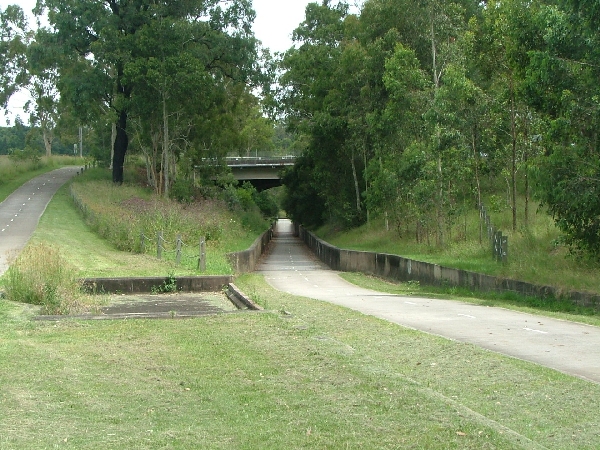 Prospect Canal Walkway/Cycleway and the Gipps Road bridge.