Questions
I am not a geologist. But when I saw the oval shape of Prospect Hill I thought it must be some sort of volcanic feature. It has been described as having a "caldera-like shape" (Holroyd 2009), but did that mean it was a true caldera? What is a caldera anyway? Is it the same as a volcanic crater?
Clearly the shape of the Hill has been substantially changed by quarrying. Did it have a caldera shape before quarrying started? Or had the inside of the hill been so hollowed out that it had attained that shape in the last 150 years or so?
How had Prospect Hill been formed in the first place?
Separation of Australia and Antarctica
It seems that the processes which created Prospect Hill started about 80 million years ago with the break-up of the supercontinent that scientists have named Gondwana. As the rift between Australia and Antarctica widened, the tension caused deep fractures in the continental crust enabling magma to rise from the mantle regions below almost to the earth's surface.
An upsurge of molten rock or magma
Geologists have described Prospect Hill as a "doleritic laccolith." This means that there was an upsurge of volcanic material within the earth's crust. Molten rock was pushed upwards below the surface and then, on meeting the resistance of hard rock, was forced to move sideways into joints in the layers of shales of the Cumberland Plain. Continuing pressure caused it to force the layer above it upwards to form a hill, but the volcanic material itself did not reach the surface forming a shallow lens within the earth.
Contact between the hot volcanic material and the rock layer above it resulted in changes in both. The volcanic material cooled into a thick disc of material and its heat also changed the nature of the surrounding rock to produce a variety of minerals. The cooling was slow because the material was insulated below the Earth's surface and this produced a variety of types of metamorphic rock in the upper part of the intrusion (England).
More technically, H G Wilshire describes Prospect Hill as "an annular teschenite intrusion which has invaded the Triassic Wianamatta shale. The outer oval shaped part of the intrusion has discordant contacts and rises about 75 feet above the central part which is occupied by a sill approximately 250 feet thick and which is overlain by 20 to 70 feet of shale." (Wilshire).
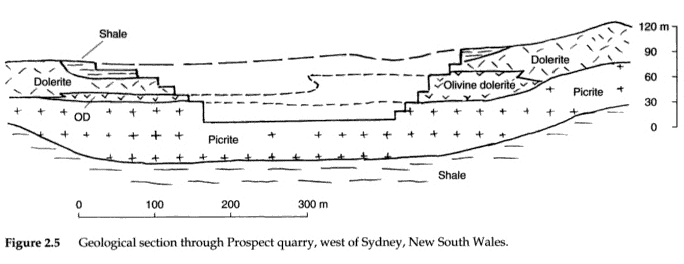
Cross-section through Prospect Hill after quarrying (McNally 1998, p 33)
The roof falls in
Over many millions of years erosion washed away the soft shales underneath the main mass of volcanic material creating a void below it. Eventually it fell in on itself and created a shallow dish-shaped formation (Boral 2).
In a normal laccolith the intruded material has a flat bottom surface and a convex upper surface so it's more like half a lens in shape. However because of the collapse of the volcanic material combined with subsequent surface erosion, the Prospect Hill laccolith had a concave upper surface until modern times, when quarrying altered its shape. This has given rise to its description as "caldera-like," although it is not a true caldera, and explains why the Hill, although a laccolith (which is normally dome-shaped), is in fact dish-shaped.
Thus Prospect Hill is neither a volcanic crater nor a caldera, since no volcanic material reached the surface of the earth. In a caldera, the collapse of the roof occurs during the volcanic period and is normally a much more explosive event (Wikipedia article "Caldera").
Erosion of the surface
The next stage of natural development, which has lasted over 60 million years, has been the slow erosion of the overlying layers of sedimentary rock by the flow of rainwater, which eventually laid bare the edges of the volcanic and metamorphic rocks of the intrusion.
So it looks as though Prospect Hill was in fact a roughly caldera-like shape before quarrying started. The quarrying has simply deepened the dish shape and steepened the inside edges of the ridge into vertical cliffs of bare rock.