Chapter 1: Growing Up
Dad was born in Cardiff in 1914 as Ronald Victor Spathaky. His father, Albert Victor Spathaky, had been born there too, the son of a Greek seaman, Antonio Spathakis, who had settled in the docks area of the city in the 1870s and married an Englishwoman, Emma Tucker. She had been born in a workhouse across the Bristol Channel in Somerset. Antonio signed his surname as Spathaky in the marriage register. After fathering three girls and three boys he died of a heart attack at the age of 40. Albert was the youngest child, just a year old when his father died. Soon afterwards, Albert’s mother Emma married another Greek seaman, Gerasimo Angulatta.
In 1913 Albert – Grandad Spathaky to me – married Clara Retchford, who was originally from Redditch, Worcestershire. Ron, my father and their only child, was born in November 1914, and they gave him a fairly conventional Anglican upbringing.
In 2011, when Dad was 96 and almost blind, I asked him about his childhood and he agreed that I should write down what he said. I had done some research in public archives and so asked him about some of the names I had come up with. When I told him that I had found that Albert’s stepfather was called Gerasimo, he replied:
I have heard the name Gerasimo many times.
Dad would have been seven years old when Gerasimo, his stepgrandfather died. He had previously told me about visiting an old lady whom he called Granny Pack; I belatedly realised that this was Emma. Although she had married Gerasimo Angulatta as her second husband when Albert was aged two, Granny Spathaky would have been the name used for her by the family, including Albert’s five older siblings and their children, since they would have known her when Spathaky was her surname.
I had a cousin Leonard who lived near the fields down by Llandaff Road… I had an Aunt Rosa who lived at the bottom of Cathedral Road. Her surname was Economides.
I knew from my family history research that Rosa was one of Albert’s two sisters. Leonard Howells was her son from her first marriage. She had remarried after Leonard’s father had died. Grandad’s other sister Maria married Vivian Thomas and Daphne was one of their two daughters.
Daphne was a very familiar name. I remember the part of Cardiff she lived in – somewhere on the eastern side; also Uncle Vivian.
What Dad never told me was that he himself was a page boy at the age of ten at Daphne’s wedding to George Harper. Dad continued:
I lived at Plasturton Gardens, in Cardiff, a street with a little park in the middle – a small park with a park-keeper who called in occasionally. I went to school in Talbot Street; Canton School was an elementary school, I think.
Modern aerial photographs show Plasturton Gardens as a well-heeled looking, tree-lined street with substantial, stone-built, villa-type, three-storey houses – and a small park in the middle.
Albert followed the profession of cinema manager until his retirement, and we think it was through their work that he met his wife Clara Retchford, my Grandma Spathaky, as she was an accomplished pianist and played for the silent films.
Decades later Dad told his granddaughter, another Emma, that he used to stand by the piano when his mother was playing in the cinema for the silent films. He also had to wobble a large sheet of metal when the sound of thunder was required.
The family moved to Cromer on the North Norfolk coast for a short while. Dad continued his recollections:
I have a sensation that I was quite small when we moved to Cromer. I remember it was quite cold so we must have been there in winter as well as summer. I went to a primary school. My dad was manager of the cinema in the town. I used to go to see the films quite often.
We lodged with some people called Blogg, who were famous as coxes of the lifeboat. Quite often they were called out to ships in distress; he went out in his oilskins. It was a terraced house. I remember walking around the town, getting to know it and the big parish church. I remember walking along the promenade in pretty cold weather.
Henry Blogg was indeed a famous lifeboatman – the most decorated one in Britain.
There was a road that struck out eastward [from Cardiff] towards Newport. I used to cycle out that way, also on towards Monmouth. There used to be fairly wide stretches of rough country to the east of Cardiff where the suburbs gave way to open farmland. All my cycling was on my own – I don’t remember any friends. I went to Cardiff High School – they tried to teach me Welsh, with little success.
This means that the family moved back to Cardiff after their stay in Norfolk.
We left Cardiff in 1926 and went to Swansea. We lived on the Gower Peninsula. I can’t remember how long. I was very fond of the Gower, a delightful part of the Welsh coast. I remember a friend called John Gill, a bookish boy who introduced me to detective stories.
Some years ago Mum told my brother Dave that there was some scandal involving infidelity by Grandad Spathaky. Apparently it was because of the scandal that they moved from Cardiff and it was also probably why Dad was an only child. Dad continued:
From Swansea I think we went to High Wycombe. We lived in a built-up but pleasant area right in the very centre of High Wycombe, a place that made furniture. I have a clear memory of the little workshops where they made the furniture by tapping dells [=dowels] into holes in the furniture to hold it together.
I kept pigeons on the roof of the cinema. I had a loft of half a dozen of them. We lived in a flat which was part of the cinema premises. I went to High Wycombe Grammar School. I can remember walking quite a walk away from the town centre up a steep hill every morning to the school which was at the top of the hill. I walked with a neighbour who used to buy a special kind of toffee, Walters’ Palm Toffee.
I think it was a boys' school. I was almost twelve, I think. I played rugby and cut my knee badly on a nail on someone's boot. The Headmaster, Mr Arneson, brought me home to our flat in his car. I studied French, Latin and the usual range of subjects in a grammar school. I was there a year at the most.
Advertisements in the Buckinghamshire Herald described Albert V Spathaky in April 1924 as the manager of the Palace Cinema in High Wycombe and “late Manager, Capitol Super Cinema, Cardiff”.
On 11th April 1925 the Herald carried an advertisement for the Palace Cinema where Lillian Gish was starring in The White Sister:
By F. MARION CRAWFORD. PALACE AUGMENTED ORCH¬ESTRA and Effects, Grand Organ, under the personal direction of Leonard Jennings and Albert V. Spathaky. Vocalist in Gounod’s Ave Maria, Miss MARGARET COLLINS. TO-NIGHT & SATURDAY, APRIL 11th. (Closed GOOD FRIDAY).
Dad was only nine years old in April 1924 so his chronology seems a bit confused. Dad said he was about twelve when they moved to Sheffield but I think he was fourteen. Certainly his father was in Sheffield by January 1929, for in that month he was convicted of several offences against the safety laws for cinemas. Part of his defence was that he had only been in the job for a short time.
Nether Edge Grammar School was the school I went to, on the edge of the built-up area of Sheffield. I walked up a hill to the school from our house in Nether Edge. We used to cross the road every day to a separate building for the school dinner. Puddings were detested by all the boys in the school. We were adept at getting rid of them behind the panels of the wall.
|
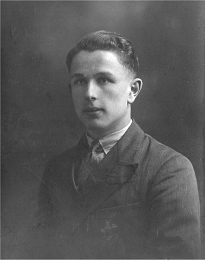
I played rugby not soccer at Nether Edge. I played scrum half. We played against Aberdare.
It seems unlikely that a school in Sheffield would play against Aberdare 200 miles away and, as Aberdare is only 25 miles from Cardiff, I guess that Dad is confused with playing rugby at Cardiff High School or at Swansea. Confusion about the chronology of the family’s moves may be because Grandad might have moved to a new job some time before Grandma and Dad followed.
I remember very clearly a rather bookish lad who was a great reader. His name was John Gill. He had read a lot of Edgar Wallace. I remember reading Wallace’s Bones of the River. I also played cricket. I took up boxing some time about then and was also good at athletics – I won the Victor Ludorum at the annual sports day. I was Captain of my House but not Head Boy. I did Latin, English and French in the Sixth Form.
I have Dad's Nether Edge sports medals. They include the Senior High Jump, 100 Yards and Cross Country in 1930, the Tug of War in 1930 and 1931, a runner-up medal for Heavyweight Boxing in 1931 and the Senior Long Jump medal for three years running, 1930 to 1932.
I remember our home at Nether Edge very clearly – a detached home with a longish garden. I was quite sweet on a girl who lived nearly opposite. But I didn’t ask her out. My parents moved away to Warrington. I moved into digs with a schoolmate. It was not a very happy time because I didn’t get on with the schoolmate.
I cycled to Paris one year. All I remember is having a very cheap road atlas. I drew a straight line on it from Warrington to Paris and followed it as closely as possible.
I remember Dad telling me this when I was quite young and showing me the actual pocket atlas with the line drawn with a pencil and ruler.
I stayed in a sort of youth hostel in Paris. I went on the Ile de la Cité, the island in the Seine, and went round the cathedral of Notre Dame. I remember the imposing towers of the cathedral… The hostel was in the rue Mouffetard in the student quarter. It was a house where a famous French scientist called Joule lived.
I met an interesting young woman living in the hostel and doing a degree course. She was nicknamed l’Impératrice by the other residents.
“Did you have long conversations into the night with her?” I asked.
Yes, my French was a bit rickety at that time. I met a male student who was very well off, I think. He dropped some kind of jewel into the river. He was showing me round Paris. We dredged the mud around where we sat but didn’t find the ring. He took us up to the Panthéon – me and one or two English people, that is.
I must have been about 15 or 16, I think. I crossed from Newhaven to Dieppe… From Warrington it took about a week to get to Paris. I was in Paris about two weeks and a week cycling back. I was already in the Sixth Form and went back to my final year at School.
Dad was a year younger than his classmates at school so it would have been 1931 when he made this trip, when he was only 16.
The following year I went to the University of Sheffield and moved into University digs.
I remember the very crowded lecture course for the new students. I got drawn into anti-fascist demonstrations. I was already a fairly committed communist through the influence of Jacob Miller, an older boy at my school. Our friendship continued at university.
So, Dad was only 17 when he went to University in 1932, his eighteenth birthday being in November. Dad’s course at Sheffield University included a return to Paris for a term spent at the Sorbonne. A few years before he died I asked if I could select a few of his books to keep, and one I chose was Sweet’s Anglo-Saxon Reader. He had written on the flyleaf, “R. V. Spathaky, Sheffield University, 3rd Year Arts, 1934”, and then “Brighton Intermediate School 1936”. He continued:
Sheffield University Union Representative Council 1935-36. Dad is in the front row, fourth from the left.
I was a member of a communist cell at the university. I became President of the Student’s Union in my final year, which became an automatic sabbatical year, so afterwards I stayed another year to complete my studies. I knew an older student called Sykes who was also a communist. He was later a lecturer in French at Leicester University.
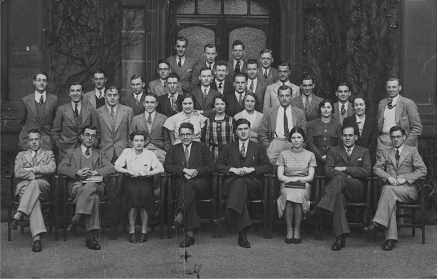
Sheffield University Union Representative Council 1935-36.
Dad is in the front row, fourth from the left.
Graham Stevenson has described the left-wing activism at Sheffield University at that time:
[Tom Driver’s] remarkable ability and intelligence saw him study English and Literature at Sheffield University, where he became the editor of ‘Arrows’, the university magazine. In 1933, he joined the Communist Party and participated in sales of the Daily Worker in Sheffield, outside the steel and engineering factories, and in the University… Tom Driver was Chair of the Sheffield University Socialist Club from 1933-35. Along with Norman Dodsworth, Tom was the thinker of the Group and, under their leadership, the Communist Party had leading positions in almost every student society, even the Christian Society!
The Communist Student Group was often called upon to lead demonstrations of the unemployed, so as to stand in for and prevent the arrest of NUWM leaders. The University Socialist Society, largely led by Communists, staged a demonstration on May Day 1935. This was the first time that students in Sheffield other than Communists had ever identified themselves with working class struggles.”
In 2009 Dad remembered Norman Dodsworth as a “charismatic leader of students”. He didn’t mention Tom Driver to me but must have known him and probably worked closely with him. Like Dad, Tom Driver later became a French teacher. By coincidence I remember Tom Driver being president of my trade union, the NATFHE , in the 1970s when I was working in community education. I didn’t know of his background or his connection to Dad at that time.
In March 1935 Dad had an article entitled ‘Anti-War’, published in the periodical New University.
On Tuesday 25th June 1935, the Sheffield Independent reported: “the award of B.A. Hons. degree, II-2, to Ronald V. Spathaky in the School of Modern Languages and Literature.” In the year after graduating, Dad added a teaching qualification to his degree. In a letter dated 7th June 1942 he refers to having worked in London as a clerk.
I didn’t link up with the university communists for some time after I left.
In 1936 he obtained a full-time teaching post at the Brighton Intermediate School in Sussex. I don’t know why he chose to move to Brighton. I know of no previous connection he had to the town. Perhaps it was simply a job that came up.