Captain Arthur Phillip, RN, Governor of New South Wales
Arthur Phillip was a conscientious, able and hard-working governor, though plagued with a constant pain in his side over the four years he was in New South Wales (1788 to 1792). He may have been chosen to lead the expedition to found the colony because of his farming experience. His writing was mainly confined to official correspondence with the government in London. This was included in the late ninteenth-century Historical Records of new South Wales, Volume 1 (Hist Rec NSW 1). It was Phillip's decision to make the first group of grants to emancipated convicts at Prospect Hill in 1791, following his successful experiment with the grant to James Ruse at Parramatta.
A comprehensive biography of Arthur Phillip appears in the Australian Dictionary of Biography Online (ADB) and need not be repeated here.
Arthur Phillip did not publish his own journal or account of his time in New South Wales. A volume was published by Stockdale of London in 1789 under Phillip's name but without his collaboration or even his permission. (Phillip 1789). The book is a compiliation of the writings of several authors, including official letters from Governor Phillip to Lord Sydney, as may be deduced from the full title: The Voyage of Governor Phillip to Botany Bay with an Account of the Establishment of the Colonies of Port Jackson and Norfolk Island; compiled from Authentic Papers, which have been obtained from the several Departments to which are added the Journals of Lieuts. Shortland, Watts, Ball and Capt. Marshall with an Account of their New Discoveries, embellished with fifty five Copper Plates, the Maps and Charts taken from Actual Surveys, and the plans and views drawn on the spot, by Capt. Hunter, Lieuts. Shortland, Watts, Dawes, Bradley, Capt. Marshall, etc. The book contains no reference to Prospect Hill.
The account of the expedition of 22nd April 1788 which climbed and named Belle-Vue is clearly paraphrased from Phillip's letter to Lord Sydney, but phrased in the third person (e.g. "On the fifth day they ascended a small eminence..."). It must be regarded as a secondary source, although other chapters are direct transcriptions of journals by other authors.
The Historical Records of New South Wales is a series of volumes published in the late Nineteenth Century. It is an invaluable source of information on the history of the colony consisting of transcriptions of documents such as reports and letters sent from Governors and other officials of the colony to the Government in London and vice versa. As such it may be considered almost as good as a primary source.
Volume 1 is invaluable as a source of the two-way correspondence between Governor Arthur Phillip and the Government in London. Phillip's letter are, of course, especially interesting, although not always accurate in detail. Phillip was not in good health for most of the time he was in New South Wales. The weight of his responsbilities took its toll too. For example, he was in some pain during the first expedition west of Parramatta and clearly did not keep a journal. His account of it to Lord Sydney was perhaps written some time after the event (part of a long letter dated 15th May) and is demonstrably in error on some points where his memory is clearly at fault. The letter was in fact his first dispatch since leaving Cape Town and reported on all the events of the intervening six months. It covered fifteen and a half pages of the printed volume. It starts:

Later in the same long letter, Governor Phillip descibes the first inland explorations, around Manly and west of the head of the Parramatta River:
In going to examine a cove near the entrance of the harbour (Shell Cove) I found a passage with deep water into a branch of the harbour that runs to the north-west, and finding on examining that there was a run of fresh water that came from the westward, I went a few days after to examine the source. I landed with four days' provision, several officers, and a small party of marines, and found to the northward of this part of the harbour a large Lake lake, which we examined, tho' not without great labour, for it is surrounded with a bog and large marsh, in which we were frequently up to the middle. There we saw a black swan; it was larger than the common swan, and when it rose, after being fired at, the wings appeared to be edged with white; there is some red on the bill, and it is a very noble bird. With great labour, in three days we got round the swamps and marshes, from which all the fresh water drains that this harbour is supplied with.
The country we past thro' when we left the low grounds was the most rocky and barren I ever saw; the ascending and descending of the mountains being practicable only in particular places, but covered with flowering shrubs; and when about fifteen miles from the sea-coast we had a very fine view of the mountains inland, the northermost of which I named Carmarthen Hills, and the southermost Lansdowne Hills. A mountain between I called Richmond Hill, and from the rising of these mountains I did not doubt but that a large river would be found, in search of which I set off the 22nd of April, with six days' provision. We were eleven officers and men, and landed near the head of the harbour. Here the country was good, but we soon came to a close cover, that we endeavoured for some time to get thro', but were obliged to return, and the next day past this cover by keeping along the banks of a small creek for about four miles. The three following days we proceeded to the westward, finding the country in general as fine as any I ever saw, the trees growing from twenty to forty feet from each other, and, except in particular places where the soil was stony and very poor, no underwood. The country thro' which we past was mostly level, or only rising in small hills, which gave it a pleasing and picturesque appearance. The fifth day we got to a rising ground, and for the first time since we landed saw Carmarthen Hills, as, likewise, the hills to the southward. The country round this hill was so beautiful that I called the hill Bellevue, but the hills we wished to reach still appeared to be at least thirty miles from us. We had been five days out, and the want of provisions obliged us to return to the spot we left, by the track we went, otherwise our journey might be lengthened several days longer than we expected, by meeting with deep ravines, which we might be obliged to go round; and, I believe, no country can be more difficult to penetrate into than this is, tho' we always found pools of water that had remained after the rainy season, yet, as that could not be depended on, the water necessary for the day was always carried, which, with the provisions, arms, and a couple of tents, obliged every officer and man to carry a very heavy load, but which at present was so much lightened, and having the trees marked, in one day and a half we got back to the head of the harbour. We had been thirty miles to the westward, and had seen a country that might be cultivated with ease, and I intended returning in a few days in hopes of reaching the bottom Landsdown [sic] or Carmarthen Hills; and the tracing of the natives inland, added to the hopes of finding a large river, which the appearance of the country promised, made everyone, notwithstanding the fatigue, desirous of being of the party; but my having when I went to Broken Bay, before I was perfectly recovered from the complaint which had been so general, slept several nights on the wet ground, brought on a pain in the side, which this journey increased so much that I found a few weeks' rest necessary after I returned.
I have had the honor of informing your Lordship that we now know there is a good country near us, and it shall be settled and cultivated early in the spring. In this journey I was surprized to find temporary huts made by the natives far inland, where they must depend solely on animals for food, and to procure which we have never yet seen any other weapon than the spear, which is certainly very inferior to our guns, and with which in this journey, tho' we were in want of provisions for the last two days, procured us barely sufficient for two meals. These huts consist of only a single piece of bark, about eleven feet in length, and from four to six feet in breath, being, when stripped from the tree, bent in the middle, and sat up as children put up a card, affording shelter against a shower of rain if you sit under it. The hut may, perhaps, only be intended to hide them from the animals they lay in wait for. Near one of these huts we found some of the bones of a kangaroo, and saw several trees that were on fire; the natives, I suppose, had left them on our approach. I also found the root of fern, or something like the fern root, that had been chewed by one of the natives; he could only have left the spot a few minutes; but we never saw any of them, and I believe their numbers in these woods must be very small. Whether they live in the woods by choice, or are driven from the society of those who inhabit the sea-coast, or whether they travel to a distant part of the country, I can form no judgment at present. The bark of many of the trees were cut in notches, and at the foot of one tree we found the fur of a flying squirrel. Many trees were seen with holes that had been enlarged by the natives to get at the animal, either the squirrel, kangaroo rat, or opossum, for the going in of which perhaps they wait under their temporary huts, and as the enlarging these holes could only be done with the shell they use to separate the oysters from the rocks, must require great patience. Against several trees where the hole was near the ground, but too high to reach, boughs of trees were laid for to climb up by. We saw many places where the natives had made fires, but at one place only were any oyster or muscle shells seen, and there not more than half-a-dozen, and no fish-bones, so that when they go inland they certainly do not carry any fish to support them.
In Botany Bay, Port Jackson, and Broken Bay we frequently saw the figures of men, shields, and fish roughly cut on the rocks; and on the top of a mountain I saw the figure of a man in the attitude they put themselves in when they are going to dance, which was much better done than I had seen before, and the figure of a large lizard was sufficiently well executed to satisfy every one what animal was meant.
In all the country thro' which I have passed I have seldom gone a quarter of a mile without seeing trees which appear to have been destroyed by fire. We have seen very heavy thunderstorms, and I believe the gum-tree strongly attracts the lightning, but the natives always make their fire, if not before their own huts, at the root of a gum-tree, which burns very freely, and they never put a fire out when they leave the place.
Near some water we saw the dung of an animal that fed on plenty of grass, and which I thought could not be less than a horse. Kangaroos were frequently seen, but very shy, and it is a little extraordinary that more of these animals are seen near the camp than in any other part of the country, notwithstanding they are fired at almost daily. Black swans are found on most of the lakes, and a bird as large as the ostrich was killed while I was at Broken Bay. It differs both from the ostrich and the emu. Several have been seen, but they are very shy, and much swifter than the greyhounds. Here are wild ducks, teal, and quails, with great variety of small birds.
In 1791 Phillip writes a further report on the progress of the colony to Lord Sydney. This is the extract in which he descrbes the founding of the settlement at Prospect Hill.
Governor Phillip to Lord Grenville
Sydney, New South Wales
November 5th, 1791
My Lord,...
[p 536:]
... we have now eighty-six settlers here and at Norfolk Island - that is, thirty-one from the marines, eleven seamen, and forty-four from those convicts whose sentences have expired; there are, likewise, more marines who have desired to be received as settlers when the detachment is to be embarked. No man of bad character has been received as a settler.
The first settler was a convict whose time being expired, an hut was built, and one acre and an half of ground cleared for him at Parramatta; he entered on his farm of thirty acres the 21st of November, 1789, and was supported from the public store until the 25th of February, 1791, when he declined receiving any further support, being then able to maintain himself. He has since married, and has a child, both of whom he wishes to take off the public store next Christmas.
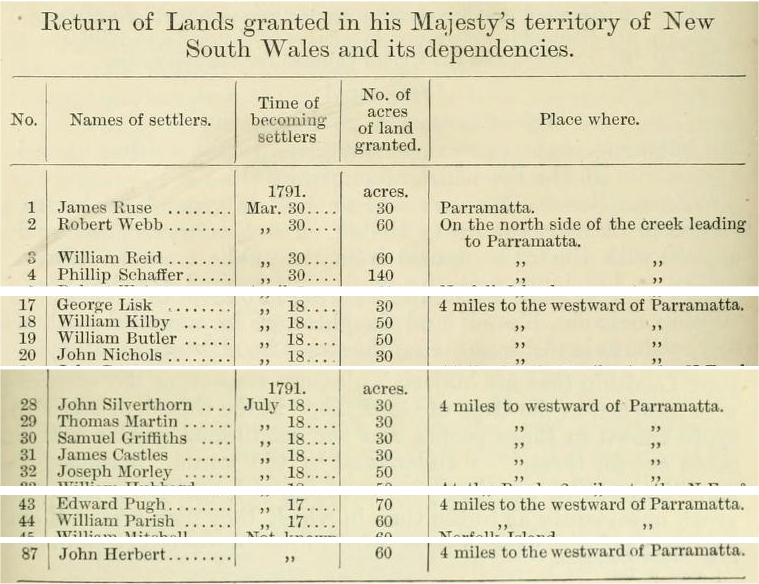
A superintendent who was sent out in the Guardian has likewise become a settler; he was not calculated for the employment for which he came out, but as a settler will be a useful man. His salary as a superintendent is to cease from the first quarter-day after he became a settler, and which he did the 30th day of March, 1791. All these people are doing well, and I hope will be able to maintain themselves when the time expires for which they are to be supported from the public stores. The times on which the settlers entered on their lands, the conditions, &c., are mentioned in the inclosed return; and as we are at some loss respecting the form of grants, I write to Mr. Nepean on the subject.
It was my intention not to receive any settlers after the marines and seamen late of his Majesty's ship Sirius had been received but according to the instructions, wich pointed out the maintaining such settler from the public store for twelve months only; but had I adhered to that determination, I must have given up all thoughts of procuring any settlers from the detachment; and any convict who might have been admitted as a settler to be supported by the Crown for one year only would have passed that year under the apprehensions of not being able to support himself at the expiration of that time, and would probably have been induced to have given up his ground before half the year was expired.
The placing the settlers with allotments of land for the Crown betwixt every two settlers was done; but being, in consequence of that disposition, surrounded with timber, out of sight and out of hearing of each other, they were exposed to a tribe of natives, who, living in the woods, and seldom coming on the sea-coast, have never mixed with us, and always have been hostile; by these people the settlers were several times alarmed, and as they were single men, or at most a man and woman, in the little hut they had reared, I found it necessary to let subsequent settlers occupy all the ground which had been set apart for the Crown. The Royal Instructions respecting the division of land may be carried into execution when large allotments of land are made, and several men are to be employed in the cultivation; but when the allotments are small, and occupied by only one person, independent of the risque the settler runs from the natives, many inconveniences attend that disposition; they cannot so readily assist each other in moving heavy timber; the labour of fencing in their grounds is greatly increased, and every man is obliged to watch his own grain, on which, from being surrounded with a wood, depredations are more likely to escape detection. I have directed Lieutenant-Governor King not to promise in future more than ten acres of land at Norfolk Island (until instructions are received on that head) to any convict who is to be admitted as a settler, and none are to be received as settlers on the island but for very meritorious behaviour.
Here your Lordship will permit me once more to observe how much we stand in need of a few honest, intelligent settlers. The vicious and the idle are not easily reformed while they are incorporated in one body. Precept has little effect, but example will do much, and although I can still say with great truth and equal satisfaction that the convicts in general behave better than ever could be expected, and that their crimes, with very few exceptions, have been confined to the procuring for themselves the common necessaries of life, crimes which it may be presumed will not be committed when a more plentiful ration renders those little robberies unnecessary; still we shall want some good characters to whom these people might look up. Having them will be attended with every advantage, and it is to be remembered that the business of cultivation is at present in the hands of few who ever turned their thoughts that way before they came to this country, and very few indeed have more than a very superficial knowledge in agriculture...
A return of the quantity of land in cultivation at Parramatta is enclosed. The town, which I have named Parramatta, extends from the foot of Rose Hill for one nule to the eastward along the creek, and I have named it Parramatta, that being the name given by the natives to the spot on which the town is situated.
I have, &c.,
[Enclosure.]
A. PHILLIP.
Ground in Cultivation at Parramatta, November, 1791.
a.	r.	p.
351	2	5 	In maize.
44	1	8 	„ wheat.
6	1	30 	„ barley. 100,, oats.
2	0	3 	„ potatoes.
4	2	0	Not cultivated ; but cleared,
4	2	15	Crescent mostly planted with vine?.
6	0	0	The Governor's garden partly sewed with maize and wheat.
80	0	0	Garden ground belonging to individuals.
17	0	0	Land in cultivation by the N. S. Wales Corps.
150	0	0	Cleared and to be sowed with turnips.
91	3	2	Ground in cultivation by settlers as per return of settlers.
28	0	0	Ground in cultivation by officers of the civil and military.
134	0	0	Enclosed and the timber thinned for feeding cattle.

[Enclosure.]
Encouragement to Settlers
The following is the encouragement given to the settlers named in the list which accompanies this:-
To James Ruse.—One acre and an half of ground, broke up, assisted in clearing the heavy timber off five acres, cloathed and supplied with the ration issued from the public store for fifteen months, an hut built, grain for sowing his ground the first year, with the necessary implements of husbandry. Two sow pigs and six hens given him.
Robert Webb and William Reid, to be supported and cloathed from the public stores for eighteen months; to have huts built for them, and to receive the necessary quantity of seed, grain, and implements of husbandry requisite for sowing the ground the first year; two sow pigs, one cock, six hens. The above two settlers likewise were assisted in clearing two acres of ground.
Philip Schaffer, himself and daughter, to be supplied with a daily ration as issued from the public stores for eighteen months; an hut to be built on the premises, two acres of ground to be cleared by cutting down the timber and burning it off the land; to have the labour of four male convicts for eighteen months, during which time they are to be victualled and cloathed from the public store; to receive the necessary tools and implements of husbandry, seed grain for sowing the ground the first year, and two sow pigs.
The marines and seamen who have become settlers on Norfolk Island to be cloathed and victualled for eighteen months, to be supplied with a proportion of grain and a proper assortment of such tools and implements of husbandry as may be necessary for clearing and cultivating the land, as well as with such a proportion of hogs and poultry as may be necessary and can be spared from the general stock of the settlement, not to be less than two breeding sows, one cock and six hens, to have half an acre of ground cleared of timber, and the necessary assistance given for building a hut sufficient to shelter the settler from the weather and secure his property.
The same encouragement will be given to those marines who may become settlers on the embarkation of the detachment for England.
Those convicts whose sentences of transportation expired and have been permitted to become settlers at or near Parramatta, are to be supported and cloathed from the public store for eighteen months, to receive two sow pigs with the necessary implements of husbandry and grain for sowing the ground the first year.
Those who have wives or children are to support them at the expiration of the above eighteen months.