A major industry
Quarrying started on Prospect Hill soon after the first time-served convicts were settled there in 1791. Small quarries were exploited for building materials. The main constituent of Prospect Hill is its dolerite, a rock similar to basalt, that is suitable for road-building. With the rapid growth of Sydney there was a need for large quantities of such rock and Prospect Hill became a major source. Small-scale commercial quarrying was underway in the 1870s in the vicinity of the present George Maunder Lookouts. By the 1820s, following the opening of the road across the Blue Mountains, Prospect Hill became a major source of roadstone for Sydney's westwards expanding road system.
|
|
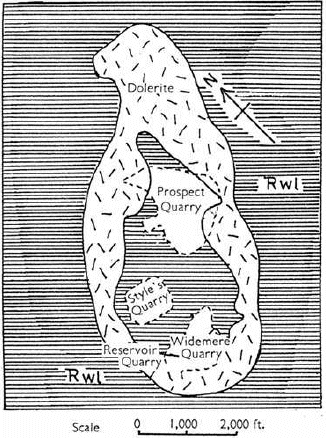
There were four major quarries on Prospect Hill - Reservoir, Style's, Prospect and Widemere Quarries. The last two of these expanded so much that in 1967 they merged to form a single large quarry complex also known as Prospect Quarry. Later this merged with Style's Quarry and eventually the whole inside of the J-shaped ridge that was Prospect Hill was one vast quarry. In some directions, especiailly in the east and south, quarrying continued beyond the original ridge line. The ridge line in effect moved outwards as well as being lowered in height.
Reservoir Quarry
The first major quarry to be opened was Reservoir Quarry on the outside of the south-west corner of the Hill. It was opened in the 1880s to provide basalt slabs to face the upstream face of the dam then being built to form Prospect Reservoir. Several smaller quarries were opened up on this side of the ridge around the same time and a narrow gauge railway was laid to link the quarries to the Western Railway.
Prospect Quarry
It appears that the first major quarry inside the ridge was Prospect Quarry opened in 1901.
Widemere Quarry
Widemere Quarry was opened in 1924 and the company which owned it built a railway leading south-westwards to join the main rail network at Fairfield. It also had a narrow gauge line within the quarry. The branch line to Fairfield was closed in 1945.
Style's Quarry
Style's Quarry was opened in 1946 on the eastern side of the west ridge of Prospect Hill. It seems to have been operated as a separately-owned enterprise until the 1980s. It may have been around that time that it physically merged with the Prospect-Widemere complex.
Gold on Prospect Hill
The following is an extract from "From the ground up - Boral's first fifty years."
One afternoon in 1961, Ron Parrot, Prospect Quarry's manager, was sitting quietly in his office at Greystanes. Bob Hooper, Prospect Quarry's foreman, suddenly burst in unannounced to tell him that gold had been discovered on Prospect Hill. Parrot said that he found that hard to believe, but Hooper was insistent. Furthermore, Hooper assured Parrot, unless he agreed immediately to the whole of Prospect Hill being pegged out with gold leases, the company could expect an influx of hundreds of gold prospectors, all staking their claims on Prospect Hill - something like the gold rushes of the 1850s and 1860s.
Hooper was a mining engineer by trade who had previously worked in Western Australia in the goldmining industry. With this in mind, Parrot reluctantly agreed to the expenditure of quite a large sum of money to take out some gold mining leases - which had to be purchased in 25-acre lots. The quarrymen pegged out BMI's Prospect Hill quarry, and then convinced themselves that the gold-bearing vein was running in the direction of Styles Blue Metal Quarry, an adjoining business. Caught in gold fever, and in the middle of the night, they climbed over the fence and pegged out Styles Quarry as well.
When Hooper staked out Styles Quarry, all hell broke loose between RMC and BMI. Sam Stirling, RMC's managing director, had secretly been negotiating to buy Styles Blue Metal and Stirling interpreted the staking out of the quarry as a deliberate attempt to prevent the sale going through. After tempers cooled, the whole matter was explained and Stirling acquired Styles Quarry for RMC.
Secure in the knowledge that they had the gold deposit claimed, Hooper set about taking an ore assay sample to confirm their find. The first sample indicated that there was indeed gold in payable quantities in Prospect Hill. However, to be sure, a second assay sample was taken which was negative, effectively quashing the potential millionaires' hopes. The site where the `gold' was discovered was a heavily mineralised shear zone, which became known as 'Hooper's Folly' (King 1996).
The end of quarrying on Prospect Hill
Prospect Quarries had been more or less worked out by the end of the centruy and in 2001 and the company developed a plan to maximise its return on the land by levelling the floor of the whole inside of the ridge, stablising the now almost vertical, inward-facing rock faces, and preparing the land for redevelopment as an industrial complex. A road, Reconciliation Road, with dedicated bus-lanes and a cycleway/walkway is being built through the centre of the Hill from Prospect Highway to Wetherill Partk.
Further details about the history of the quarrying of Prospect Hill can be found in the references (Holroyd 2005, King 1996 and Wallace 1992.).