The glittering jewel in the crown
|
|
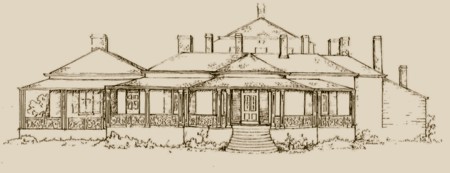
The Crown of Prospect Hill - that beautiful hill that is such a landmark for many miles around - is occupied by Greystanes, formerly occupied by Nelson Lawson, but subsequently, at various times, asscoiated with the names of Walter Lamb, F. W. Wentworth and A. F. Smart. This fine old estate is owned by Capt. P. Charley of Belmont Park, and is undoubtedley one of the finest properties in Central Cumberland, the view from the gardens being magnificent. (Nepean Times, Old Prospect, 25 Sep 1909).
Thus wrote William Freame in 1909. The site is close to the present One Tree Hill, the "one tree" being a Moreton Bay fig tree, which still survives, having been planted in the garden. The position can be identified on the map of grants shown on the Settlement page of this web site. The map shows a grant of 75 acres to William Cummings, which was made in 1799. He was an ensign of the New South Wales Corps. His grant was originally "three allotments of 25 acres each granted by Col. Paterson to three privates in the N.S.W. Corps." (Ryan 1981, p 128).
William Lawson purchased the 75 acre grant from Cummings at about the same time, in 1810, as he was granted 500 acres on the the western slopes of the west ridge of Prospect Hill. He made his home, eventually the house named Veteran Hall, on the 500 acre property, and in 1836 transferred the 75 acre grant to his third son, Nelson Simmonds Lawson. It was on this site that Nelson Lawson then built the house which he named Grey Stanes in 1837.
On the NSW Heritage Branch web site we read:
Greystanes was approached by a long drive lined with an avenue of English trees - elms (Ulmus procera), hawthorns (Crataegus sp.), holly (Ilex aquifolium), and woodbine (Clematis sp.) mingling with jacarandas (J.mimosifolia). It had a wide, semi-circular front verandah supported by 4 pillars. The foundations were of stone, the roof of slate, and the doors and architraves of heavy red cedar. It was richly furnished with articles of the best quality available and was the scene of many glittering soirees attended by the elite of the colony. (Heritage, Prospect Reservoir and surrounding area).
Unfortunately the NSW Heritage Branch seems to confuse the two Lawson properties, Veteran Hall on the north-west slope and Grey Stanes on the "crown" of the eastern ridge of Prospect Hill. However the avenue of English trees definitely led to Grey Stanes (Heritage, Prospect Reservoir and surrounding area).
|
|
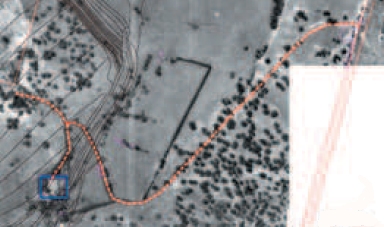
The position of the house is pin-pointed on an aerial photograph in Holroyd City's Prospect Hill Conservation Management Plan (Holroyd 2005, p 50 ). This image also shows the route of the "long drive lined with an avenue of English trees" which curved in an S-bend down the steep part of the ridge and then across the hillside to where the gates still stand on Greystanes Road.
Nelson Lawson died in 1849 and Grey Stanes passed first to his widow, who remarried, then to his brother William Lawson, the eldest son of William Lawson of Veteran Hall. The subsequent, complex ownership history is detailed on the Prospect Heritage Trust web site (ProspectHT, Greystanes House). The property still covered 75 acres as late as 1884. After that Arthur Smart purchased surrounding properties and is thought to have built the gates which still survive on Greystanes Road and the gate lodge which once stood beside them.
From 1898 landowners, including Captain Charley, were primarily interested in quarrying. The property came into the hands of Blue Metal Industries, the predecessors of Boral. Much of the property is now covered by the Nelsons Ridge housing development in the newly-created suburb of Pemulwuy. The original house, Grey Stanes, fell into disrepair, a process accelerated by vandalism, and was demolished in or sood after 1946. Its site has now been quarried away and, as the ridge line has moved east through quarrying, is located somewhere west of the present One Tree Hill.
[Match aerial photo 1946 to topo maps of similar date.]